PostgreSQL on RHEL 9.6: Does the Archive Keep Updates Coming?
PostgreSQL 18 from PGDG runs on your RHEL 9.6 server, and that repository is being archived. What happens to its updates, and what are your options?
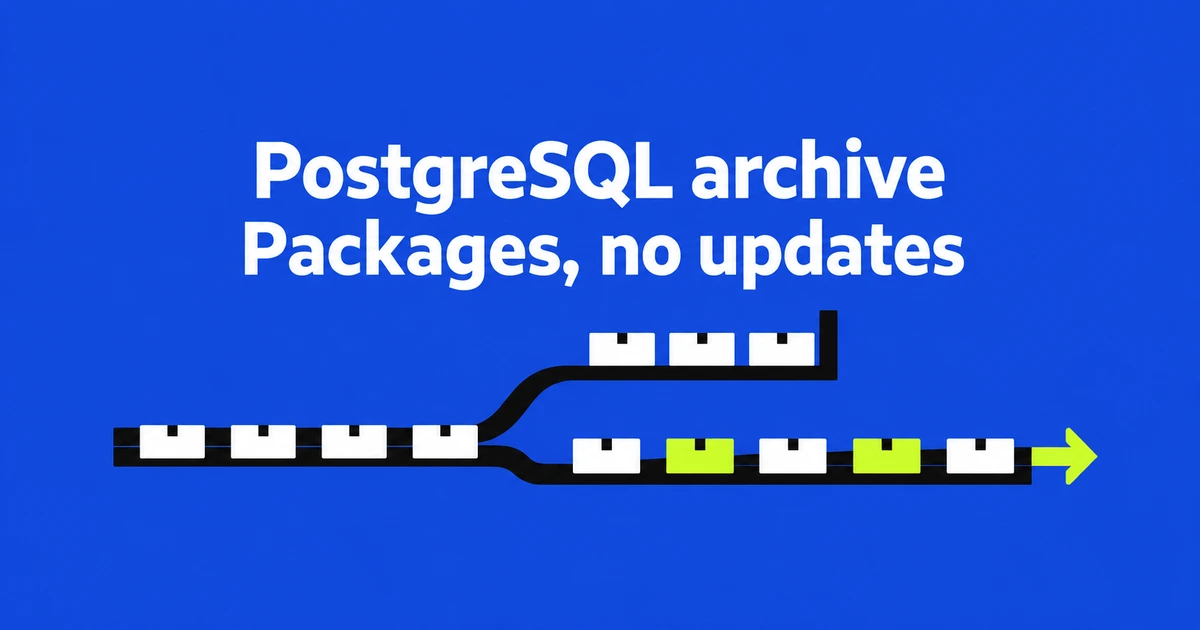
- PGDG is archiving its RHEL 9.6 and 10.0 repositories without further updates.
- The corresponding Rocky Linux and AlmaLinux releases are included.
- Check the installed OS and repository configuration before choosing an upgrade or archive access.
A working download source does not guarantee new packages
Switching a RHEL 9.6 or 10.0 host to the PGDG archive restores access to historical packages, without continuing their updates. The October 20 retirement announcement covers the PostgreSQL versions built for those OS releases, including PostgreSQL 18.
For a team keeping machines on a fixed OS release, obtaining an installer and securing future maintenance are separate decisions. Successful installation alone does not settle the second one.
Identify the package supplier before changing repositories
The retirement includes matching Rocky Linux and AlmaLinux releases. PGDG explicitly excludes the rolling EL-9 and EL-10 repository RPMs from the change. That exclusion does not promise continuing builds for a retired OS minor release.
The PostgreSQL download page distinguishes distribution-supplied packages from the PGDG repository. A PostgreSQL installation supplied through AppStream, for example, has a different support path. The database's presence or major version alone cannot identify whether this particular retirement applies.
An updated OS can still have an old repository URL
Check the distribution release and architecture, then read the configured base URLs. These commands inspect configuration without changing it:
cat /etc/redhat-release
uname -m
grep baseurl /etc/yum.repos.d/pgdg-redhat-all.repo
PGDG's September repository RPM update addressed URLs staying pinned after the OS moved forward. New configurations use DNF's OS version variables. Compare the installed release with the repository destination instead of assuming they match.
If the failing URL literally contains $releasever_major or $releasever_minor, investigate variable expansion too. PGDG documented that issue with RHEL 9.6 and repository RPM 42.0-69, followed by a fix in 42.0-70. Fixing that older configuration problem does not reverse the October retirement.
Match the archive configuration to the actual host
If the host can move forward, choose a currently supported OS minor release. PGDG describes its RHEL-family coverage as the latest two minor releases. Updating the OS package path does not by itself require choosing a new PostgreSQL major version.
If the OS must stay put, the Archived repositories selector asks for distribution, OS version, architecture and PostgreSQL version, then supplies the relevant configuration and installation commands.
It also configures available common and extras repositories. Tools such as pgBouncer, pgBackRest and Patroni live in common; some dependencies live in extras, which is disabled by default. Account for those tools alongside the database package, and set a date to move to a maintained package path.