Firefox’s Two-Week Releases: What ESR Actually Changes
Firefox Release has shipped every two weeks since version 155 on September 1. If you manage company desktops, what do you gain and lose by switching them to ESR?
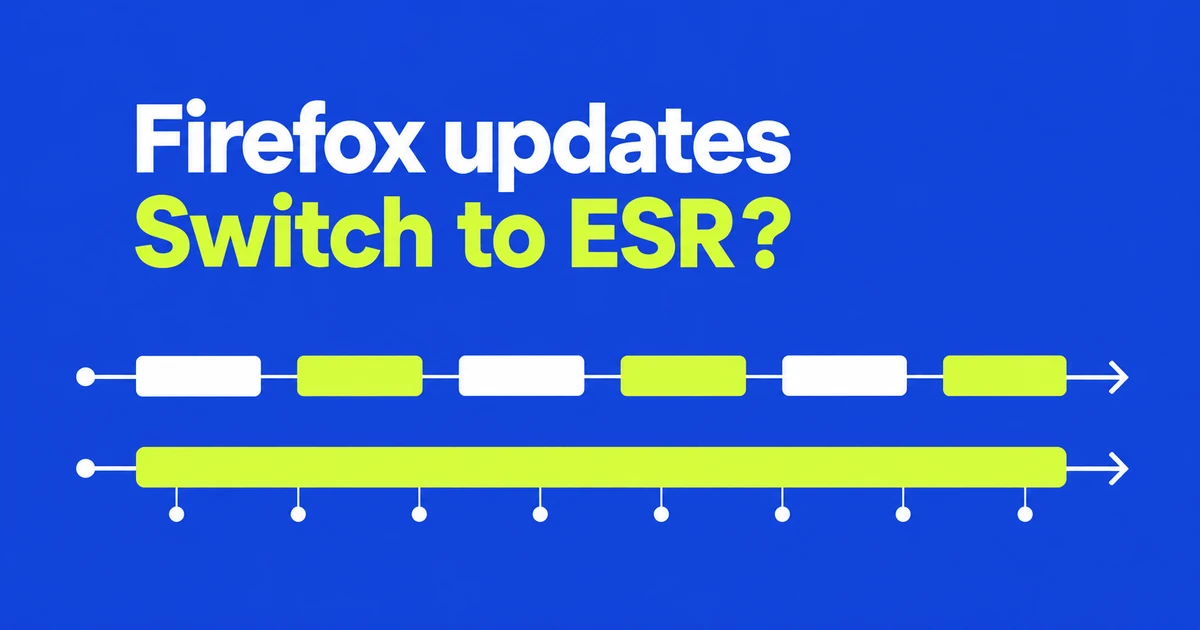
- Firefox’s two-week Release cadence began with version 155 on September 1.
- ESR reduces major feature churn while continuing to receive security updates.
- Urgent patches and schedule adjustments still happen. Use Mozilla’s release calendar for deployment planning.
More releases do not mean twice as many features
Firefox has already moved from a four-week Release cycle to a two-week one. Mozilla’s August announcement identifies Firefox 155, released on September 1, as the first version on that schedule.
Mozilla’s stated aim is to deliver completed features and fixes sooner with a more predictable rhythm. It explicitly rejects the idea that the change means twice the feature output. Additional dot releases remain possible when needed.
ESR separates major feature changes from security maintenance
Mozilla’s channel guide positions ESR for environments that value long-term compatibility and consistent behavior. Major feature and interface changes arrive in annual ESR releases, with security updates in between.
| Decision | Release | ESR |
|---|---|---|
| Major-version cadence | Normally two weeks. | Annual releases. |
| Priority | Receive new features and improvements quickly. | Maintain longer-term compatibility. |
| Validation work | Review feature and interface changes more often. | Reduce repeated testing of major changes. |
The useful distinction is how frequently features change. Installing ESR and leaving it untouched misses the security-maintenance side of the channel.
October 20 brought patches to both channels
ESR 153.5.1 shipped on October 20 with security fixes. It is a concrete example of maintenance continuing within an annual ESR generation.
On the same day, Release 158.0.1 addressed problems including pages jumping to the top during text selection and a Windows crash when printing or saving a PDF with assistive technology running. Intermediate releases still have practical work to do between major versions.
For deployment planning, keep major-feature validation separate from the process for applying security and bug fixes. An ESR fleet still needs someone to watch the release notes for its branch.
Use the calendar instead of adding fourteen days
The release-process documentation excludes urgent patches from the standard two-week interval and allows adjustments for holidays or business needs. The cadence is a planning baseline, not a promise of exactly one update every fourteen days.
Mozilla’s administrator guide directs readers to the release calendar for upcoming dates and programmatic release information. Pair that schedule with the relevant release notes when setting testing and rollout dates.
Choose Release for faster access to features, or ESR to reduce major-change validation. Keep applying security maintenance whichever channel you choose.
FAQ
Can ESR machines be updated only once a year?
No. Annual releases carry major feature changes; security patches continue between them.
Does the two-week cycle eliminate dot releases?
No. Mozilla still issues additional patches when needed, as the October 20 releases illustrate.