RX 9070 XT vs RTX 5070 Ti: How Much Is the GeForce Premium Worth?
Both cards offer 16GB, yet your checkout totals are hundreds apart. Which games and settings give you a reason to pay the difference?
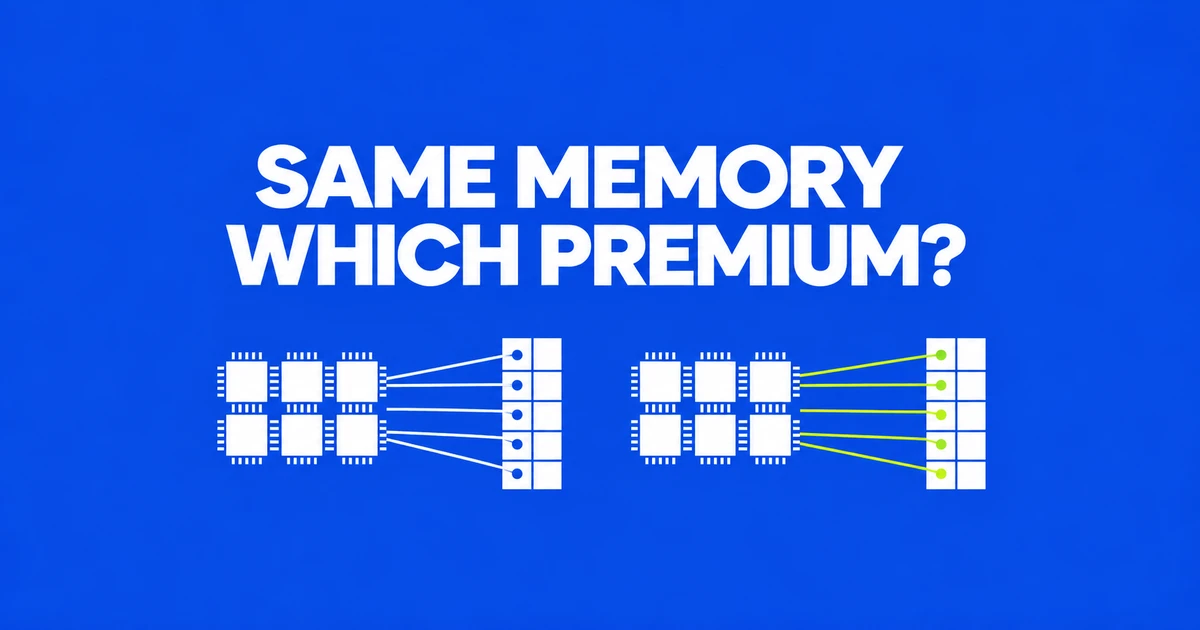
- The RX 9070 XT is the stronger value choice when it costs substantially less and your gaming priorities do not depend on a specific GeForce feature. Paying more for the RTX 5070 Ti makes sense when the games and effects you actually use reward it.
- A May 2026 TechSpot test put the Ti about 1.4% ahead at 1440p and roughly 4% ahead at 4K across its mixed-settings suite. Individual ray-tracing workloads require a separate comparison.
- Both have 16GB. Compare complete checkout costs, the settings you want to keep, and the exact board model before treating a small average lead as a reason to spend hundreds more.
The useful question is how much the GeForce premium buys in your own games. A small price difference is easy to justify with a preferred feature. A large difference needs a clearer benefit, especially when both cards sit close together in broad gaming tests.
Start with the experience you want to preserve: native rendering, a particular ray-tracing preset, or an upscaled image you like. Those choices give the price comparison a purpose. A general promise of better gaming says much less than a result at the settings you intend to use every week.
Put the premium into the complete build
Consider a hypothetical $700 RX 9070 XT and $900 RTX 5070 Ti. These are example prices, not current retail quotes. With $800 of identical remaining components, the finished systems cost $1,500 and $1,700.
| Hypothetical purchase | RX 9070 XT build | RTX 5070 Ti build |
|---|---|---|
| Graphics card | $700 | $900 |
| Other components | $800 | $800 |
| Complete system | $1,500 | $1,700 |
The GPU premium is 28.6%; the system premium is 13.3%. Neither percentage says what the additional $200 does for your games. If performance rises by just 4%, the more expensive GPU has about 23.6% higher cost per frame. A buying decision at those prices therefore depends on benefits beyond that modest average increase.
This also explains why a whole-build argument has limits. Calling an upgrade a small percentage of the PC makes the expense look easier to absorb. It does not increase the performance gained from that expense. Keep both numbers visible: the additional cash required and the improvement in the workload you care about.
Broad averages leave little room for a large premium
TechSpot’s May 2026 comparison covered 52 games at two presets, mixing configurations with and without ray tracing. At 1440p, the Ti led by about 1.4%. At native 4K, the averages were 84fps for the Ti and 81fps for the Radeon.
The platform used a Ryzen 7 9800X3D, DDR5-6000 CL30, Windows 11 25H2, and drivers 596.49 and 26.5.2. This is a dated, mixed-workload result, rather than a raster-only ranking.
A result this close favors the cheaper card when the aim is simply to buy broad gaming performance. It also makes a personal shortlist useful. Someone who spends most evenings in one demanding game has less reason to weight fifty other games equally than someone who moves between many releases.
At 4K, a small average advantage deserves context. It is valuable if it resolves a limit you actually encounter. It is less compelling if both options already provide the experience you want. Look at demanding scenes and frame consistency alongside the average before paying a large premium to move a summary bar slightly farther right.
Ray tracing changes the answer game by game
Ray tracing is a category of rendering work, and games use it in different amounts. The label alone does not tell you the performance gap between two GPUs.
In GamersNexus’s 2025 launch testing, the RX 9070 XT averaged 103fps in Dragon’s Dogma 2 at 1440p with RT, essentially matching the Ti. In its Dying Light 2 1440p RT test, the Radeon averaged 89fps and the Ti led by about 16%.
Those examples support a practical distinction. Paying extra for a ray-tracing preset you intend to use is easier to justify when the relevant game shows a meaningful gap. A general preference for the words “ray tracing” is weaker evidence, especially if the effect you enable places a lighter load on the GPU.
Relative performance and acceptable performance are separate buying questions. A faster card can still need an adjustment to reach your target. When comparing results, keep output resolution, RT quality, upscaling mode, and frame-generation status attached to the numbers. Otherwise the apparent advantage can describe a different experience from the one you are buying.
Upscaling results need a version and a setting
Upscaling reconstructs a higher-resolution image from a lower-resolution input. Frame generation inserts additional frames between rendered ones. AMD’s FSR documentation presents them as separate functions. A benchmark with both enabled answers a different question from one using upscaling alone.
A November 2025 TechSpot comparison found a 5% Ti lead at native 1440p across 22 games, shrinking to 2% with Quality upscaling. It used DLSS 4 and FSR 4 with drivers 581.57 and 25.10.1. The geometric-mean result describes that software combination.
By October 2026, GPUOpen lists FSR Upscaling 4.1.2, while NVIDIA’s current DLSS overview includes 4.5 features and DLSS 5. The older test cannot settle the performance or image-quality comparison of every current implementation.
For a purchase, inspect the games on your shortlist. Determine which features they actually expose and which visual compromises you accept. A matching Quality label does not guarantee an identical image. Thin objects in motion, interface elements, and trailing artifacts are more useful things to inspect than a feature name on a product page.
Generation multipliers need their own context. NVIDIA describes 6X Multi Frame Generation as adding five frames per rendered frame in supported configurations. That multiplier counts images; it does not establish a sixfold improvement in input response. Base performance and latency remain relevant when deciding whether the result feels right.
The same capacity does not make these the same card
The Radeon specification and GeForce specification show a shared capacity but different memory types.
| Manufacturer specification | RX 9070 XT | RTX 5070 Ti |
|---|---|---|
| VRAM | 16GB GDDR6 | 16GB GDDR7 |
| Memory interface | 256-bit | 256-bit |
| Board/graphics power rating | 304W TBP | 300W TGP |
| Baseline PSU recommendation | 750W | 750W |
The Ti does not increase capacity over the Radeon. Equally, its newer memory type does not predict a fixed uplift in every game. GPU design and the workload determine how the complete card performs. Sixteen gigabytes is a capacity consideration, rather than a guarantee that any 4K preset will run at the frame rate you want.
The power ratings also do not establish a four-watt difference in actual play. They are manufacturer specifications, rather than simultaneous measurements of the same scene. An electricity-cost calculation requires measured consumption and an explicit usage pattern.
Check the exact retail board before checkout. Its dimensions, cooler, connector arrangement, and PSU recommendation affect installation. Paying extra for a quieter board is another decision again, requiring noise and thermal results for that model. A premium cooler and a faster GPU tier solve different problems.
Choose the cheaper performance, or pay for a specific experience
For a new gaming build, choose the RX 9070 XT when it is substantially cheaper and its results at your preferred settings meet your target. There is no requirement to spend the savings elsewhere. Meeting the target for less money is already a useful outcome.
The RTX 5070 Ti earns a premium when a game you care about rewards its RT performance, or when you prefer the supported GeForce features you will actually enable. If checkout prices are close, those benefits become easier to choose. As the price gap grows, they need to matter more.
Owners of either card face a different calculation. Switching between these two does not increase VRAM capacity, and a small average change provides little reason to absorb resale losses. Identify the specific setting or experience the replacement unlocks, then compare that benefit with the cash remaining after selling the current card.