Can 4reel Handle Stereo Vision for an Arduino Robot?
Add a second camera to an Arduino robot, and something has to match each object between the left and right images. How much of that work can a 4reel board take on today?
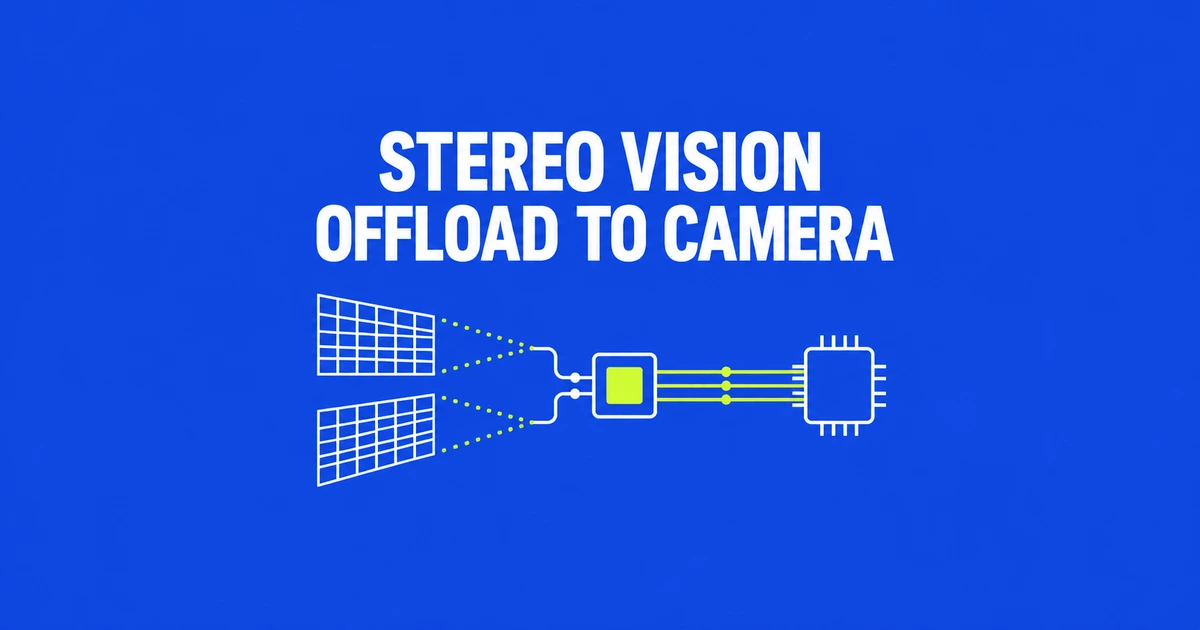
- 4reel is a small Linux stereo-camera project intended to serve robots whose controllers lack the compute for machine vision.
- It uses Rockchip's SAD accelerator to help match corresponding regions in two camera images.
- The October 6 development log places SLAM and YOLO in future work; the current README describes a broader platform. The shop showed sold out on October 26.
Stereo processing runs on the camera board
4reel is designed to process stereo images on its own Linux board and send data to an Arduino or ESP32 over UART. That lets a robot retain its existing controller while moving the vision workload onto the camera hardware. USB-C serves a different role: it exposes an Ethernet interface for configuration.
The official hardware listing specifies a 1.1GHz ARM Cortex-A7 processor, 64MB of RAM and two OV9281 global-shutter cameras, along with 4MB flash and an SD-card slot. It combines image capture with a separate Linux environment.
Ryan Walker's October 6 development post, recently discussed on Hacker News, describes building the design around the Rockchip RV1103.
Matching a patch gives disparity, not a distance in meters
Walker's approach compares small image regions using the sum of absolute differences, or SAD. Shifting one image horizontally and finding similar patches helps locate corresponding points. The chip's hardware engine accelerates this operation.
The resulting shift is disparity. OpenCV's stereo-depth tutorial expresses the relationship as d = Bf / Z, where B is the camera separation, f the focal length and Z the depth. With the same camera arrangement, a larger disparity indicates a nearer point. Converting the shift into distance requires those camera parameters.
Matching also depends on the scene. OpenCV describes weakly textured regions and object boundaries as sources of problematic matches. Searching a larger disparity range increases computation. For a robot, the practical question is therefore whether correspondence remains reliable across the intended scenes and operating distances.
The software stack includes proprietary acceleration code
Walker used Buildroot to assemble the bootloader, kernel and operating environment. His application obtains camera frames through V4L2 and schedules work on the Rockchip Video Engine using the proprietary librve.a library.
The development post says the MIPI drivers, hardware accelerators and other components came from the vendor BSP. Published board files do not make that an entirely upstream Linux stack. Anyone extending the design also inherits a driver and library integration problem.
Separate the depth demonstration from a complete navigation product
The October 6 post demonstrates capture and depth processing, then identifies SLAM and YOLO implementation among possible next steps if there is sufficient interest. SLAM concerns building a map while estimating the robot's position within it.
The current README describes the platform as capable of stereo depth processing, classification and SLAM. That broader statement does not specify a completed navigation system's accuracy or frame rate. The detailed development account and the platform description answer different questions.
On October 26, 2026, the official shop listed the camera as sold out. Availability and the supplied software remain relevant to someone seeking a ready-to-use device. For builders, the immediate value is the published example of moving stereo computation onto a small Linux board with dedicated acceleration.