Does Replaying an AI Agent Undo Its Completed API Calls?
The customer record was created, but the connection dropped before the agent received the response. Will replaying the call create that customer again?
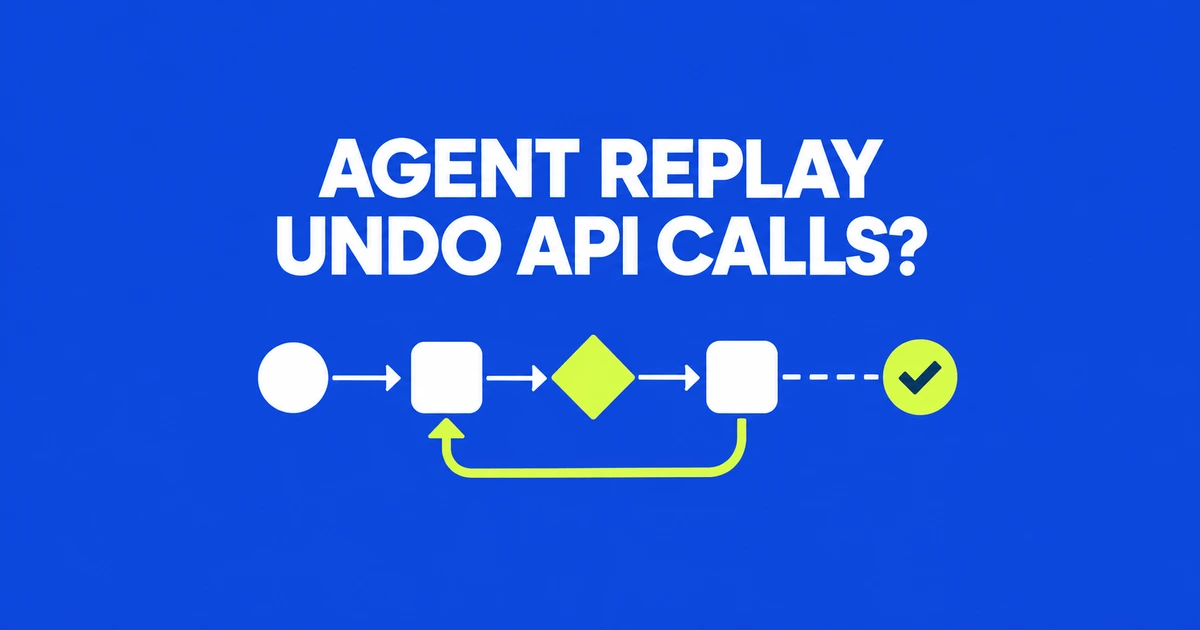
- Replaying a LangGraph checkpoint can repeat later API calls.
- Jukebox can discard explicitly staged file writes before commit.
- External retries need the destination service’s duplicate-request controls.
A checkpoint does not rewind an external service
Moving an agent back does not automatically cancel work its tools completed. LangGraph’s time-travel documentation says nodes after the selected checkpoint execute again, including model and API calls. Earlier nodes use their saved results.
Consider a workflow that creates a customer record and then fails. Selecting a checkpoint before creation is a different operation from deleting that record. Likewise, update_state creates a branch; it preserves the original history.
Jukebox stages file contents before writing them
The newly shared Jukebox-OS project proposes recording agent activity and explicitly committing or discarding proposed changes. Its quickstart demonstrates that pattern with a staged file write.
In the public Python implementation, stage_file_write holds content in memory. Commit writes files sequentially; rollback clears the staged lists. It does not restore files already written, and it writes a rollback record. These are the boundaries of the Python 0.1.0 code available on October 26, 2026.
Identify the state of the actual change
A useful recovery decision starts with what happened at the destination:
| State | Decision |
|---|---|
| Proposed write, not committed | Can the pending change be discarded? |
| External operation completed | Keep its result or request a supported cancellation. |
| Request sent, response lost | Check how the provider recognizes a retry. |
These questions separate restarting computation, abandoning pending work and reversing completed work. A recovery feature can solve one without providing the others.
Let the provider recognize the same operation
Stripe’s idempotent requests illustrate the external side. For API v1, a key identifies a request whose response is saved after execution begins. Reusing that key returns the stored status and body, helping avoid duplicate creation after a connection failure.
The guarantee has boundaries. Stripe can prune keys once they are at least 24 hours old; reusing a pruned key creates a new request. Changing parameters while reusing a retained key produces an error.
Before replaying a write, establish whether the goal is to cancel a completed action or safely retry an uncertain one. Then match the recovery path to the destination’s actual contract. A saved agent state alone cannot make that choice.