Can AI-Generated Dashboards Replace Looker? What You Still Have to Run
At a company of roughly 500 people, an AI-built HTML dashboard service matched Looker’s weekly users after about eight months. Does that mean the Looker contract can go?
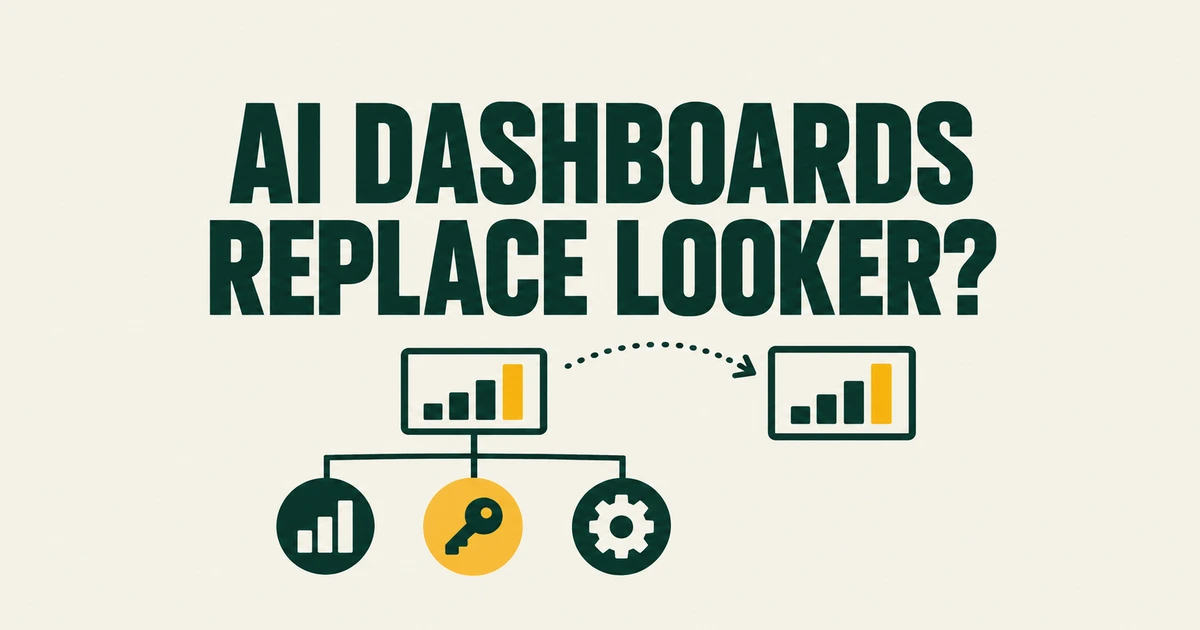
- An AI-generated interface still needs governed metrics, data permissions and an operator.
- Adoption of a new dashboard service is different from retiring a BI contract or proving net savings.
- Looker Data Apps, currently in preview, offers another route: new interfaces on existing models.
Replacing a report starts below the chart
An AI-built page can replace a reporting interface. Retiring enterprise Looker also requires a destination for the definitions, permissions and operational features behind that interface. This is a decision about Looker, not a Looker Studio report.
LookML models centralize business metrics and relationships. If your revenue definitions live there, drawing a similar HTML chart has not migrated them. If those definitions and access controls already live elsewhere, a custom interface has less work to take over.
The reported adoption is real progress, not a complete cost comparison
In his October 14 account, David Lequin says an internal HTML dashboard service at a roughly 500-person company reached about Looker’s weekly user base after eight months. The team already had dbt models and Snowflake permissions. Some Looker dashboards still lacked replacements, and his cost comparison excluded engineering labor.
Those conditions matter to another team’s budget. Count the workloads actually migrated, the subscriptions still retained, infrastructure and the time spent maintaining the replacement over the same period. A popular new interface identifies demand; it does not by itself establish which contract can be reduced.
A database permission does not constrain dashboard JavaScript
Data authorization and browser execution need separate designs. Snowflake OAuth provides token-based authentication and authorization through configured integrations. Connecting it does not establish the execution boundaries for uploaded JavaScript.
MDN’s iframe documentation warns against combining allow-scripts and allow-same-origin for content sharing the parent’s origin: the embedded document can remove the sandbox attribute. “Behind SSO” and “inside an iframe” are incomplete descriptions of a security design.
A team building the service therefore needs owners for credentials, code execution boundaries, publishing and rollback. Faster page generation increases the value of making those controls reusable.
Keeping Looker’s models is also an option
Google announced Looker Data Apps in preview on October 12. It hosts agent-generated applications within Looker, using existing semantic models, row-level security and access controls. That is a route to a different interface while retaining the platform.
| Your starting point | A useful first evaluation |
|---|---|
| Metrics and permissions already live elsewhere, with an operating team. | Move one workflow to custom hosting and measure the ongoing work. |
| Looker contains the important definitions and controls. | Compare migrating that foundation with extending it through data apps. |
| Teams disagree on basic metrics. | Settle definitions and ownership before multiplying interfaces. |
Choose one consequential report for the pilot. Match its dates and filters against the existing output, then test access with different accounts, sharing and scheduled delivery. Identify the cost that can disappear when that workflow moves—and who will run what replaces it.