Why AI Time Savings Do Not Automatically Become Company Profits
Workers in a Bank of Korea study saved about 1.5 hours a week with AI, yet output growth barely moved. What has to happen before saved time shows up in profits?
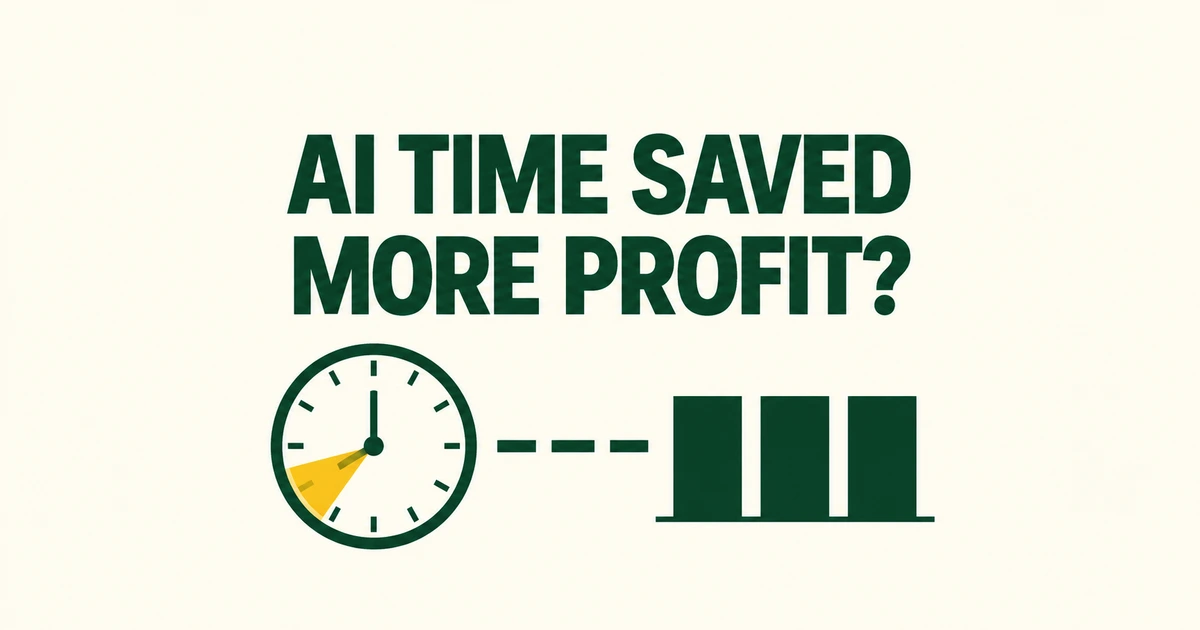
- Finishing a task faster does not automatically increase company revenue or profit.
- Apollo highlights a performance gap between the Magnificent Seven and the remaining S&P 500 companies.
- Evaluate time saved, completed output and financial changes separately.
Time saved is an input to a business result
Completing the same report faster improves task efficiency. Whether the company finishes more work, lowers costs or sells more is a separate question. For example, shorter drafting time does not itself establish revenue growth if the number of contracts completed by month-end stays unchanged.
This distinction allows employee time savings and flat company performance to coexist. The missing link is what the organization does with the time released.
Apollo sees a gap beyond the Magnificent Seven
In an October 24 analysis, Apollo chief economist Torsten Slok argues that revenue per worker and margins are rising for the Magnificent Seven but flat for the remaining S&P 500 companies. His test is whether cheaper AI translates into stronger revenue and margins across mainstream businesses.
That is a company-performance question, not a task-timing experiment. The S&P 493 also means the index excluding seven companies; it is not a classification that removes every technology business.
The workflow after the faster task still matters
A June Bank of Korea study reports average work-time savings of 3.8%, roughly 1.5 hours weekly, but essentially no overall relationship between time savings and output growth. Self-employed workers and professionals were among the exceptions.
The researchers’ explanation points to rigid workflows, bottlenecks and incentives as possible reasons. Faster report preparation cannot remove a slow approval stage. These Korean worker findings illuminate a conversion problem; they do not measure US company margins.
Financial gains are uneven across companies
PwC’s 2026 Global CEO Survey found that 12% reported both cost and revenue benefits from AI, while 56% reported no significant financial benefit. Published in January, it covered 4,454 CEOs in 95 countries and territories surveyed from September 30 to November 10, 2025.
Respondents reporting both benefits were more likely to report extensive AI integration across business activities. This is a relationship in survey responses, not proof that installing a tool produces a particular return.
Ask three separate questions about a rollout
A practical evaluation can distinguish the stages these findings describe:
| Stage | Question |
|---|---|
| Task efficiency | How much time is saved at the same quality? |
| Operational output | Does that enable more completed work or services? |
| Financial result | What changes in costs and revenue, including rollout and operating expenses? |
A single productivity percentage hides where progress stops. If time falls but output stays flat, examine workflow and bottlenecks. If output rises without better profits, examine the costs and revenue attached to it. That connection gives the next investment a clearer rationale than usage alone.