Hidden App Features Can Cost You an Apple Developer Account
Your reviewer sees one version of the app, and users get extra features once it’s approved. What does Apple’s October 16 guideline change mean for apps built that way?
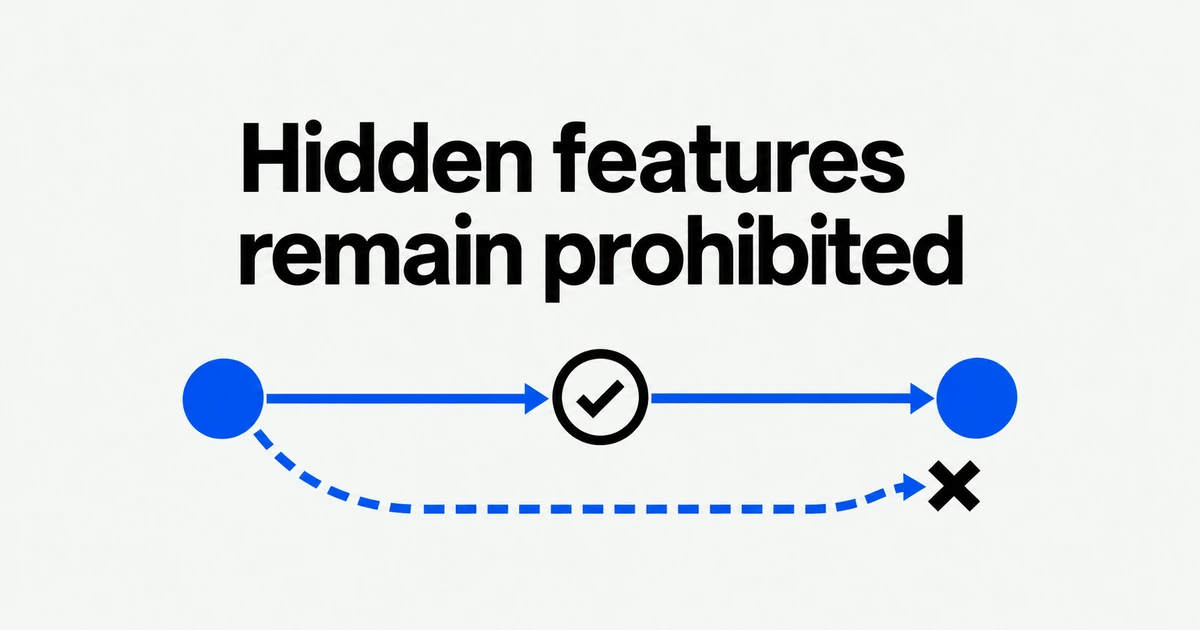
- Apple’s October 16 revision places its existing prohibition on concealed, dormant and undocumented features in guideline 2.5.19.
- AI content creation apps fall within the user-generated content rules, including responsibility for preventing and removing nonconsensual intimate imagery.
- New functionality needs specific review notes and access for reviewers. Approval does not authorize a concealed change in what the app does.
The section number is new; the prohibition is not
Apple’s October 16 change notice describes guideline 2.5.19 as a clarification of a longstanding policy previously covered by 2.3.1. Hidden, dormant and undocumented features were not an accepted route to shipping an app before this revision.
A separate announcement identifies bait-and-switch behavior: presenting one purpose during review and exposing harmful capabilities after approval. Apple links the clarification to its efforts against apps that conceal those capabilities.
The announcement is not a blanket ban on AI applications. Its relevant distinction is between the functionality presented for review and what an app conceals until approval, alongside its responsibility for harmful content.
Reviewers need to reach the functionality, not just read about it
Guideline 2.5.19 requires the app’s behavior to be clear to users and App Review. Attempts to conceal undocumented functionality in the binary, including through obfuscation, are grounds for app removal and developer account termination.
Guideline 2.3.1(a) separately requires specific descriptions of new features and product changes in Notes for Review, with access for reviewers. A vague “feature improvements” note does not communicate a significant new capability.
For a development team, this means documenting the conditions and navigation needed to reach screens restricted to particular accounts or settings. Calling a mechanism a feature flag or an A/B test does not settle the policy question. The relevant issue is whether functionality is concealed from review and revealed afterward.
AI content creation apps have moderation responsibilities
Guideline 1.2 explicitly includes AI content creation apps alongside social media and UGC platforms. Its scope covers creating, generating, uploading and sharing content.
Apple’s accompanying announcement says platforms must proactively prevent and remove nonconsensual intimate imagery, including material generated with AI tools. Providing a reporting button without the operational response does not address both parts of that responsibility.
| Requirement in 1.2 | What the app must provide |
|---|---|
| Filtering | A way to filter objectionable material before it is posted. |
| Reporting and response | A reporting mechanism and timely responses to concerns. |
| User blocking | The ability to block abusive users from the service. |
| Contact | Published information allowing users to reach the operator. |
Failure to implement appropriate safeguards or remedy notified violations can become a Developer Code of Conduct issue. The guidelines allow immediate removal from the App Store and Apple Developer Program for egregious or repeated conduct. They do not describe every report as triggering the same penalty.
Make review notes specific and the review account usable
The App Store Connect reference explains that App Review information is not visible to customers. Notes can contain settings and test account details, can be written in any language, and have a 4,000-byte limit.
Apps requiring sign-in need demo account credentials, and the account must not expire. Details for additional accounts belong in Notes. If different roles expose different screens, mapping each account to the functions it can reach is a practical way to make the submission understandable.
Before submitting, check that the review account can reach the features, the necessary backend is available, and the description matches the actual behavior. Those checks help present a change as an inspectable part of the submitted app.
Frequently asked questions
Did Apple first prohibit hidden features in October?
No. Apple describes 2.5.19 as clarifying an existing policy previously covered by guideline 2.3.1.
Is mentioning a feature in review notes enough?
No. Guideline 2.3.1(a) also requires access for review. The description and the reviewable functionality need to match.
A release needs an accurate description and accessible functionality at review time. Responsibility for AI-generated user content continues after approval.