TorchNeuron: Is Moving PyTorch to Trainium Really a One-Line Change?
Your PyTorch model runs on Trainium after changing one line, but it’s slower than you expected. What else has to change before the move is really done?
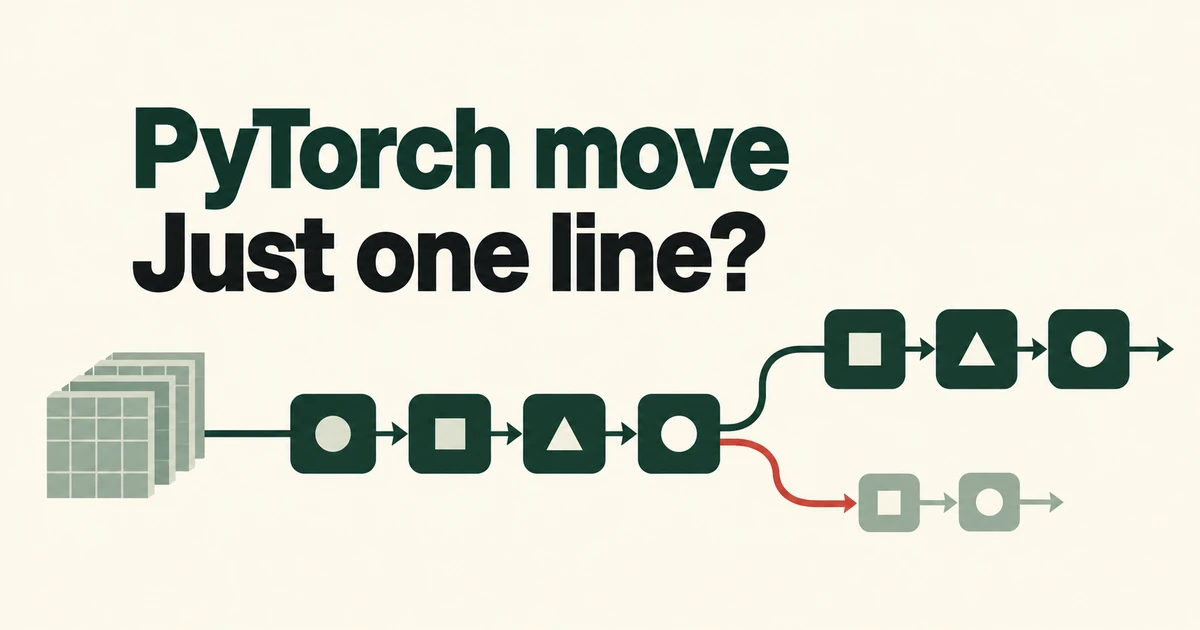
- Changing the device is only one step in moving a PyTorch model to Trainium.
- The public beta has API limits, and some eager operations can fall back to the CPU.
- Test representative static shapes, inspect fallback operations and separate first-call compilation from cached execution.
A native device makes the entry point familiar
AWS’s October 20 announcement presents .to('neuron') as the route into TorchNeuron. The open-source public beta runs on EC2 Trainium2 and Trainium3 instances, giving developers a native backend for existing PyTorch work.
That simplifies device selection. It does not settle whether a particular model’s operations are supported. Inputs must also reach the device, and code written for the older XLA-based Neuron library needs changes for the new backend.
Keep the debugging workflow; choose how to optimize
The development team’s PyTorch article describes eager execution for interactive work with Python control flow, prints, and breakpoints. For optimization, torch.compile captures the model or selected regions as graphs. NKI provides a route to custom kernels for performance-critical operations.
The team’s model sweep used reduced, representative configurations and checked loading, forward and backward passes, compilation, and which operations fell back to the CPU. Those are distinct questions. A successful model load alone is a weak basis for signing off a production migration.
The compiler documentation also describes a different path from a GPU setup: StableHLO and the Neuron compiler replace TorchInductor. CUDA-only compilation arguments need attention.
The beta has an explicit support boundary
The Neuron 2.33.0 release notes specify these requirements:
| Area | Supported configuration or limit |
|---|---|
| OS | Ubuntu 24.04 or 26.04 on Linux x86_64. |
| Packages | Matching torch-neuronx families for PyTorch 2.13.0 or 2.14.0; Python 3.12, 3.13, or 3.14. |
| Unsupported APIs | torch.sparse, torch.func, torch.nested, and torch.distributions. |
| Eager fallback | Some unsupported operations can execute on the CPU. |
Use torch_neuronx.get_fallback_ops() to inspect recorded fallback operations. Keeping execution going does not mean every operation ran on Trainium.
Separate first-call compilation from steady execution
The compiler currently requires static shapes with dynamic=False. Different input shapes can trigger separate compilations. The caching guidance recommends padding or bucketing inputs to reduce the number of shapes and improve cache reuse.
Compilation failure has a separate fallback mechanism. Returning to the original, uncompiled graph after a compilation or execution failure is disabled by default; errors are surfaced. Do not confuse that mechanism with eager operations falling back to the CPU.
A useful migration trial records results and timings for representative shapes, separates cold-cache calls from warm ones, and inspects CPU fallback. The device switch starts the migration. Your model’s operations and inputs determine whether it is ready.
FAQ
Will all existing PyTorch code work unchanged?
No. Check the supported APIs and package combinations, along with CUDA-specific options and any older XLA device code.
Does a slow first call predict every inference call?
No. Initial compilation can add latency, while later calls with matching inputs can reuse cached artifacts. Measure them separately.