Hurston-1 TTS: Can an Accent Prompt Keep the Same Voice?
A podcast host sounds right in episode one, then a new generation keeps the accent but not the voice. Is there a way to hold one speaker across Hurston-1 prompts?
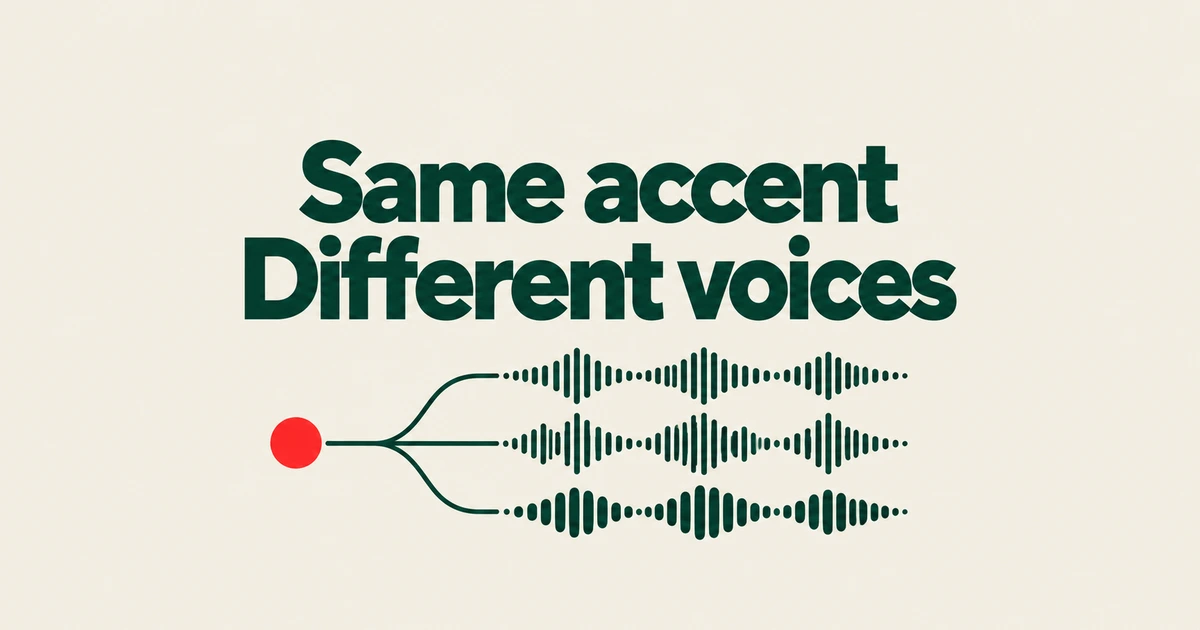
- Hurston-1 offers accented English generation without preserving one speaker across prompts or cloning a specific person.
- Varied test callers and a recurring narrator have different requirements.
- Telephone audio output still needs the correct message format and call integration.
A repeated accent prompt does not preserve a narrator
Destined AI’s creator states in the Show HN announcement that Hurston-1 does not maintain exactly the same voice across prompts and does not support voice cloning. That limitation matters immediately for a recurring podcast host or a recognizable brand voice.
A test suite has a different goal. Generating an appointment sentence with varied speakers can help exercise a speech-recognition system. Whether it understood the appointment and whether it heard the same speaker as before are separate questions.
Before adopting the model, decide whether your application needs variety or continuity. One convincing sample does not settle the latter.
Keep voice direction separate from the words to speak
The Hurston-1 model card documents English accents including Southern U.S. and regional African English. It is an English-only model; regional accent support does not add support for other languages.
Its base model, Maya1, takes a voice description alongside an utterance. Written directions describe vocal characteristics; the utterance supplies the spoken content. This is a different interface from providing a recording of a particular speaker.
For an application test, keep the sentence fixed while changing the requested voice. Use the names, numbers and short responses your service must handle, then score the spoken content separately from the desired accent.
Phone mode does not supply the whole call integration
Hurston-1 can process synthesized audio into telephone-band, 8 kHz G.711 mu-law output. That is useful for testing under a telephone audio constraint. Sending the result into a live call remains another step.
Twilio Media Streams expects a media message containing base64-encoded raw mu-law audio at 8,000 Hz. Its payload must exclude audio file headers. Encoding an entire WAV file is therefore not the required payload.
Twilio also buffers audio in arrival order and accepts a clear message to interrupt buffered playback. A telephone-compatible waveform does not implement turn-taking or interruption handling for the application.
Check model access before starting a local evaluation
The Hurston-1 page displays an access gate asking users to agree to share Hugging Face information. A visible model page does not mean its files can be downloaded anonymously.
Under Hugging Face’s access process, a signed-in user requests access in the browser. Approval can be automatic or manual, and scripted downloads require authentication for an authorized account.
Once access is available, prepare a small set of real application sentences and assess accent, intelligibility and speaker continuity separately. Hurston-1 is worth examining for varied English test voices; a fixed narrator requires a capability its creator explicitly says this release does not provide.