Copilot Industry Comparisons: What the Leverage Score Measures
Every developer on your team now uses Copilot agents, and your leverage score against the industry just fell. How does full adoption lower the number?
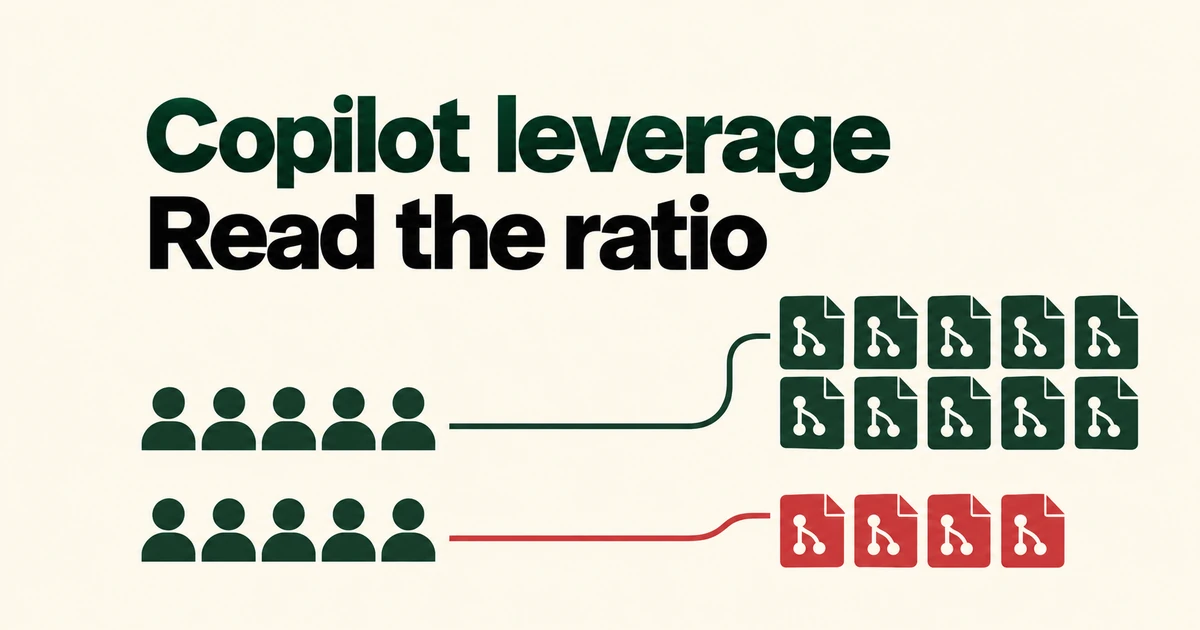
- Leverage is a ratio of PR merge rates per user across agentic and non-agentic groups.
- A higher ratio does not establish hours saved or isolate the productivity effect of agents.
- Industry comparisons cover opted-in businesses. Keep the period, peer group and denominator with any reported score.
The benchmark covers participating businesses
GitHub’s October 22 update adds an Industry comparison section for enterprises and organizations outside an enterprise. It places their adoption and leverage scores alongside aggregated peer benchmarks.
Participation is off by default. Even the All industries view represents businesses that opted in, rather than every company using GitHub. Comparisons use a displayed 28-day period and group participants by company size and industry.
Those grouping choices are self-reported and unverified. A benchmark copied into a management report therefore needs its period and actual peer group attached.
Leverage compares merge rates, not hours saved
The dashboard guide defines two distinct measures:
| Measure | Definition | Different from |
|---|---|---|
| Agentic adoption | The share of active users classified as agent-first or multi-agent. | The share of all employees or purchased seats using Copilot. |
| Leverage | Agentic users’ PR merge rate divided by non-agentic users’ rate, per user per month. | A multiplier for time saved, code quality, or revenue. |
The adoption phases describe product engagement, not developer ability. They depend on the surfaces used and qualifying activity days. High completion volume alone does not move someone into an agentic phase.
On that definition, a higher leverage score establishes a merge-rate difference between groups. It does not isolate how much of the difference was caused by agents. Calling it a PR merge-rate ratio preserves what was measured; calling it a productivity multiplier adds a claim the comparison alone cannot establish.
No ranking can mean no usable comparison
If an industry group is too small, GitHub expands to all industries within the same company-size band. If that group is still too small, there is no ranking. The top-decile comparison requires more peers than the median, so the median can appear on its own.
Your own denominator can also be missing. When every active user is agent-first or multi-agent, there are no non-agentic users to establish a leverage baseline. That produces an unavailable comparison rather than a maximum score.
For GitHub Enterprise Cloud with data residency, peers remain within the same region. Expanding across industries does not combine regions. The cohort label identifies the comparison you actually received.
Opting in combines viewing and contributing
The Copilot usage metrics policy must be enabled. Enterprise owners and owners of organizations outside an enterprise can opt in. Enterprise-owned organizations participate through the enterprise; enterprises used only for assigning Copilot Business licenses are ineligible.
The data-protection documentation says participants contribute two summary scores for the period. User names, code, repository content, and PR content are not contributed to peer comparisons.
Opting out removes the comparison display immediately and excludes contributions from the next daily update. Previously calculated aggregate results are deleted after 30 days. Industry comparisons are unavailable through the API, NDJSON exports, and downloads.
Use the widget to put adoption in the context of participating peers. Keep the period, cohort, and denominator with the score, and support broader delivery or business-outcome claims with their own evidence.
Frequently asked questions
Does universal agent adoption produce the highest leverage score?
No. If all active users are agent-first or multi-agent, there is no non-agentic baseline for calculating leverage.
Can I export the industry ranking through the usage metrics API?
No. Industry comparisons are dashboard-only, even though other usage data is available through the API.