Copilot HydraFusion vs Max: When Is Deeper Reasoning Worth It?
One answer comes back, but behind it HydraFusion drafted, critiqued and revised across several model calls. When is that extra credit spend worth it over Auto?
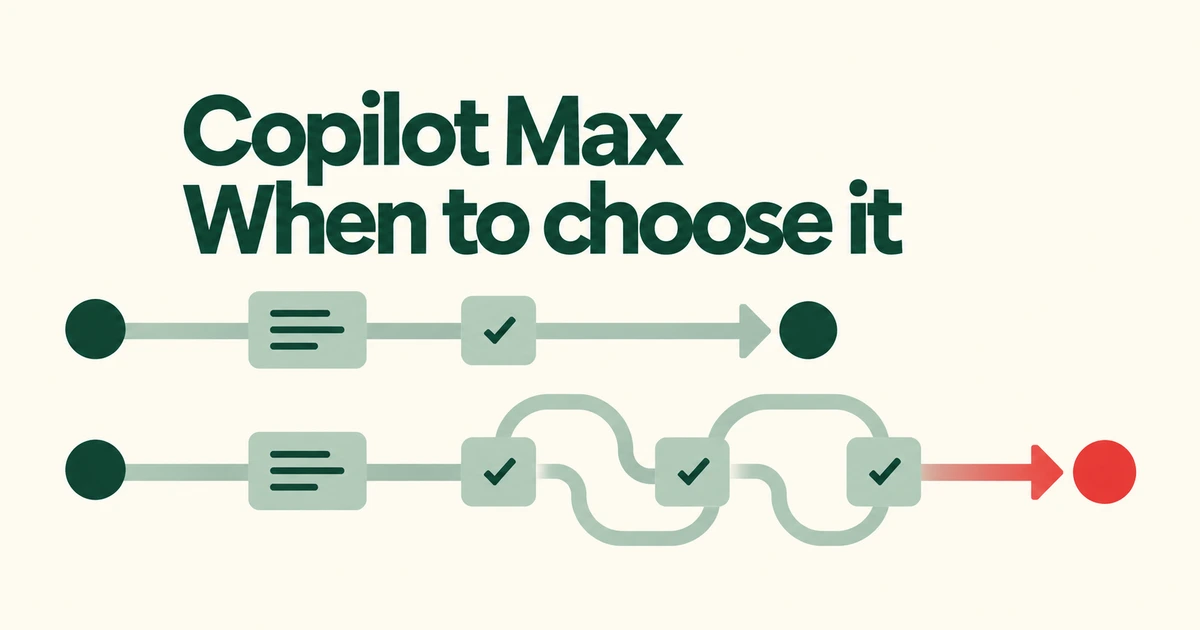
- Auto suits everyday work; HydraFusion can add model passes for substantial coding tasks.
- Max uses the same orchestration approach with deeper reasoning for demanding work.
- Additional passes can take longer and consume more credits, without the Auto discount.
Choose Max for depth, then judge whether it helped
HydraFusion Max is the option to evaluate when a coding task warrants deeper reasoning. In its October 14 update, GitHub positions standard HydraFusion around a balance of speed, cost and capability, with Max aimed at harder work. Both remain research previews.
| Task | Option to consider | Decision |
|---|---|---|
| Routine questions and edits | Auto | Let Copilot select a model. |
| A complex bug or a change spanning files | HydraFusion | Decide whether additional review warrants more time and usage. |
| Work requiring the deepest analysis | HydraFusion Max | Evaluate the benefit of higher reasoning effort. |
Auto already has a quality-focused choice. Its Efficiency, Balance and Intelligence tiers adjust routing priorities. A difficult prompt does not automatically require Max; the additional question is whether you want a workflow that can bring in another model to inspect the work.
A turn can use one model or include review
HydraFusion appears in the model picker but orchestrates models. Its documented execution patterns include Single, Cascade and Critique: finish with one model, judge a draft before possible escalation, or critique and revise it. The pattern can change between prompts in one conversation.
Max shares that architecture. It increases reasoning effort where depth matters; it does not mean every available model must participate in every request. GitHub chooses the model mix.
One answer can contain several billable stages
There is no separate HydraFusion fee. Each participating model is charged at its standard rate, and the Auto discount does not apply. Drafting, review and revision can therefore accumulate more usage than a single-model response.
The pricing reference bases cost on the model and token consumption, including input, output and applicable cache charges. One AI credit represents $0.01. The length of the final answer alone cannot reveal how much work preceded it.
A useful comparison keeps task scope similar and records both usage and the changes you accept. Counting participating models or assuming a fixed Max multiplier misses the tokens each stage consumes.
Check usage alongside the patch
In an updated Copilot CLI, start with copilot --experimental, open /model and select HydraFusion or Max. Use /usage for model-level credit consumption. VS Code and the Copilot app also support the feature, subject to preview settings and model policies.
Inspect the working tree before committing: discarding a draft does not automatically undo its file edits. Start ordinary work with Auto, then compare standard HydraFusion and Max on tasks where another review pass has a concrete purpose.